Saturday, 19 November 2011

Jews in post-independence Greece

In his book, The Jews of the East, Dr. Ludwig Frankl reports on the miserable state of Jews in post-independence Greece. At the time of Frankl’s visit, Greece did not yet include several major Jewish population centres. Salonika and Rhodes were under Turkish rule, while the Ionian Islands were a British protectorate.

… a few words must be said about the Jews, in Greece, in general. There is nothing to prevent the Jews from settling in Greece; before the law, they enjoy the same constitutional rights as the other citizens; still, very few of them are to be found here. They were numerous under the Turkish Government, and, because faithful to their lawful masters, they took no part with those who fought for liberty, when the latter proved victorious, they were destroyed with fire and sword. On the day of the atonement, in the year 1821, the Greeks captured Tripolitza [Tripoli, in the central Peloponnese], and massacred the whole of the Jews assembled at prayer. The Greek fought with and for the cross; the Jew could not advance with him to battle, and, even when oppressed by the Mohammedan, felt himself more closely allied with him, in religion, through their common belief in the unity of an invisible God.

Only one of the former Jewish communions in Greece survives at the present day – at Chalcis, in the island of Euboea, because it remained longest, till the year 1833, in the possession of the Turks, and was first surrendered, when Greece was declared free and erected into a kingdom. Fugitives from Spain – according to another account which I have received from Mr. Von Hahn, consul at Syra, fugitives from Venice were the first who settled at Chalcis, 600 years ago, and formed a communion, which now contains 300 souls. They speak Spanish and Greek. They are very poor; most of them support themselves as mechanics, or dealers in fruit; the whole community assembles in a miserable little synagogue every morning and evening; their Rabbi’s name is Benjamin Cohen. They have a vote in the election of the Members of the Chamber of Deputies, and there is nothing to prevent any one of them, if possessed of sufficient education, from being chosen a member. They live on the best terms with neighbouring Greeks, among whom they occupy a peculiar position as a colony, and nothing but their poverty prevents them from obtaining land, and directing their attention to agriculture.

Till the year 1854, there were only two Jewish families living at Athens; since that time, eight or ten from the island of Zante have settled here. As yet, they have not formed themselves into a community, and on high feast days, they have divine service in a room engaged for the occasion; when a death occurs, the body is interred in the Christian cemetery.


Source: The Jews of the East, written by Dr. Ludwig August Frankl, an Austrian doctor, and translated by Rev. P. Beaton in 1859

Jews in the Ionian Free States, 1850s


The Ionian Islands had been a Venetian outpost for almost five hundred years. They fell to France when Napoleon occupied Venice in 1797. They were briefly occupied by the Russians before being returned to France in 1807. The British took the islands in 1809. Once Greece became independent in 1830 the Greek islanders wanted to join that country, which did not actually happen until 1862.

The report below is from the last days of British rule. No longer on one of the world’s major trade routes, between Venice and the Ottoman Empire, bullied by the majority Greek population and perhaps aware the British are leaving, the small Jewish community was in a sorry state.

Mr. Chazan spoke of the very sad condition of the Jews in the Ionian Free States. There were four thousand of them in Corfu, and two thousand in the Island of Zante. Most of them are engaged in trade; only a few support themselves as mechanics. Scarcely any of them are in comfortable circumstances, and notwithstanding the proud title, Ionian Free States, and the Protectorate of England, they neither enjoy liberty not are they free from oppression.

Jewish children are mocked at in the schools, girls altogether excluded. The Jews of Zante had just drawn up a representation to the Government, begging that their deplorable social condition might be ameliorated.


“Better a learned heather than a high priest who is an idiot,” quoted Mr. Chazan, from the Talmud.


Source: The Jews of the East, written by Dr. Ludwig August Frankl, an Austrian doctor, and translated by Rev. P. Beaton in 1859

Friday, 18 November 2011

Jews in the Mediterranean, 1818

Letter from Rev. William Jowett to the London Society for Promoting Christianity amongst the Jews. Malta, August 4, 1818. I think he gives at interesting insight into the state of Jewish communities in the Mediterranean at the end of the Napoleonic Wars.

“When I was at Corfu, in the autumn of 1816, I was very intimate with the most learned of the Jews in those parts, rabbi Lazzaro Mordos. He is an old man, nearly blind, and quite deaf, a physician; … He has no Hebrew books of English typography. For this part of the world, Venice formerly, but latterly Vienna, have been the chief place for Hebrew printing: and still more recently, Leghorn.

[He comments on how well the Jews in Ionia got on with the French, and that they are now protected from the Greeks by the British.]


I have been credibly informed, that the condition upon which the Jews enjoyed toleration at Rome, was – beside payment of money – an attendance upon a weekly lecture delivered by some learned priest in one of the churches; in which the question between the Jews and Christians was regularly discussed. The attendance of the Jews residing at Rome was obligatory:


I would here observe, that beside the thousand Jews at Corfu, they are numerous in Albania, Thessaly, Venice and northwards towards Constantinople. At Salonica they are said by some, to be more numerous even than the Turks and Christians put together. At Yannina, the metropolis of Ali Pasha, they have much influence, a Jew being the treasurer of that Pasha; liable, of course, to heavy exactions, all which however that oppressed people have too long learned to bear. In Athens, where I was lately, they informed me there are no Jews; but in the neighbourhood, in Livadia and northward, they abound.

In Smyrna, the Jews and Armenians are the principal brokers to the Frank merchants, and discharge their trust in such a manner as to raise their character somewhat high. I have heard merchants speak with great respect of their fidelity, as well as diligence. The number of these brokers, however, must be small in comparison with the bulk of the Jewish people there. In must also strike you, that there are often circumstances in which it is more for a person’s immediate interest to be honest, than to be roguish. It is to be lamented that the Jews have seldom been dealt with on this footing: they have been unfairly treated, and have seldom enjoyed the equal rights of humanity.


At Scio [Chios] there are not above 60 or 70 Jews; and these live for the sake of security within the walls of the Turkish fortress, They fled thither during some disturbances, in which the Christians were ill using them; and having found safety there, they do not stir out, but give themselves to handicraft trades.


The number of Jews in Malta is at present very small; not more I am told than fifteen or twenty families.


It is not thus with the Jews of Leghorn and Triest. As far as I have seen or heard of these, they have a liberality bordering on infidelity; something very much of the Sadducee character. There may be 15,000 at Leghorn; they are rich and enterprising. They have a synagogue one of the most splendid in the world. They print largely here, and in all respects enjoy great liberty. At Trieste they had about three years ago a a distinguishing mark of the emperor’s favour: he visited their synagogue in person, which event they commemorated by a Hebrew inscription.

I have received several very interesting notices respecting this people from Dr. Richardson, an English physician, just returned from his travels in Egypt and Syria. At Cairo they have seven synagogues; at Jerusalem they have two, but poor-looking. At Damascus, the population of which he thinks to be upwards of 300,000 the Jews are numerous. At Tiberias – once so highly famed for Hebrew literature – he visited a college which still exists there. Here he found five rabbies (sic), living apparently in learned leasure, with a library of no mean size, well supplied with Hebrew Scriptures and commentators. One of these was in great repute for learning. … The late Djezza, that terrible character, the Pasha of Acre, had a Jew for his principle Minister: with his well known brutality he cut off the man’s nose, put out one eye, and otherwise mutilated and disfigured his face.


I will add an article which I received from an English gentleman, intimately acquainted with the state of that regency [Tripoli]. “Their number in Tripoli is estimated at 3,000; they had seven synagogues, and pay an annual tax to the Bashaw of about two thousand dollars. They are governed by their Caid, who is appointed by the prince, but whose power extends to the punishment only of offences, not capital. The Jews in the vicinity are likewise under his authority; but those of Bengazi and Derne have their respective Caids. The number in those places may be reckoned at 1000. The rabbies in Tripoli are about twenty, who are paid from three to four dollars a week. In the vicinity of Tripoli (called the Gardens) there may be about twenty Jews, who have no synagogue, but pray in their houses. An annual visit is paid by a rabbi from Jerusalem, who is appointed by the chief of the holy land for the purpose of collecting money; and who may get in Tripoli a thousand dollars. They have synagogues at Arzon, Tagioura, Tajur, Mesurata, Bengazi and Derne. Their printed books they have from Leghorn, their manuscripts from Tunis.”

Report on the Jews in Tunis, 1818

Extract of a Letter from Dr Cleardo Naudi of Malta to the Rev. C. S. Hawtrey, June 20, 1818, printed in the The eleventh report of the London Society for Promoting Christianity amongst the Jews.

He reports that there were around 12,000 Jews in Tunis, divided between the Leghorn [Livorno] Jews and Tunesian (sic) Jews. Tunis had been the main African market for French goods during the Napoleonic Wars, and the Jewish community had done well. There was little interaction between the two communities and (surprise, surprise!) the Livornese looked down on Tunisians.

“The first, or Leghornese, do not exceed the number of seven hundred. They are governed by three Parnassi or Massare, and like those of the Jews of Leghorn, are elective, and have no duties but such as related to their religious ceremonies. Their liturgy is that of the Spanish synagogue; they are for the most part natives of Tunis, and consider themselves the descendants of the exiled families of Spain during the persecutions in that kingdom. They wear the European dress, and those how have not the means of doing so wear the hat for distinction. They have no dealings with the Tunesian Jews, and, during a period of seven ages, they count but four inter-marriages – in an event of this nature taking place, the party is excluded from their synagogues, and considered as one who has degraded himself. – They have also a separate market. Corporal punishments seldom occur, as is daily the case with the Tunesian Jews. Theirs are generally of a pecuniary nature.”


They did not "consider" themselves the descendants of the exiled families of Spain. That is exactly what they were!

I like the idea of the poorer community members in Arab clothes and tricorn hats.

"Remarkable for the haughtiness"

I found this gem on Google Books. It was published in The Living Age magazine in 1846. I think it gives an honest account of Sephardi Jewish disdain towards the Ashkenazim in mid-19th Century Britain. As a "Portuguese Jew of London" I can confirm that a healthy self-regard is still a characteristic of our community. Fortunately, under the influence of Moses Montefiore and others, the arrogance and disdain towards our Ashkenazi co-religionists disappeared over the following fifty years.

"The Portuguese Jews of London could never drop their national characteristic; they were remarkable for the haughtiness, their high sense of honour, and their stately manners. Subsequently, Jewish emigrants flocked from Germany, Poland and Barbary, a race in every respect of inferior rank. The Portuguese shrank from all contact with them; different synagogues separated them; and the Lusitanian Jew would rather have returned to the fires of Lisbon than have intermarried with the Jew of Alsace or Warsaw. The latter was humiliated by indigence, and pursued the meanest and not infrequently the most disreputable crafts. The former, opulent and high-minded, indolent, polished and luxurious, splendid in dress and equipage, felt himself disgraced by the beard and gabardine of the Polander."

Francisco de Goya


I believe the correct title for this painting by Goya is "Court of the Inquisition". As the victims/accused are wearing sanbenitos I would think the painting depicts an auto de fe - the reading of the charges, followed by acts of repentance for the penitent and punishment for the impenitent. Tribunals of the Inquisition operated in total secrecy and without an audience. Smaller autos were conducted in churches, monasteries or Inquisition premises, and that may be what is shown here.

Goya was active in the early 19th Century, by which date the Inquisition was in decline. After invading Spain Napoleon abolished the Inquisition, but it was reconstituted after the French were ejected.

It appears that a Dominican monk is reading the charges, while members of the nobility sit in the foreground and clergy in the background. It was considered meritorious for aristocrats to attend autos de fe.

If the flames on the victims' hats are pointing upwards, then they are already condemned to be burnt to death. They will have been informed the day before. Generally non-heretics, and heretics who repented (or said they did), were garrotted before the fires were lit.

Wednesday, 16 November 2011

Where to start?


I assume anyone reading a blog like this has already spoken with older relatives, downloaded some free genealogical software, perhaps read a book and joined a genealogical society. I have the worst organised notes of anyone I ever met, so would be ashamed to lecture you on the subject.

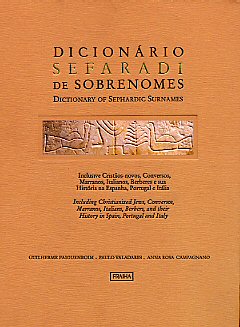
If I were to recommend a single resource to get you started on Sephardi genealogy it would be the Dictionary of Sephardic Surnames (Dicionário Sefaradi de Sobrenomes) by Guilherme Faiguenboim, Paulo Valadares, Anna Rosa Campagnano. They have created a surnames directory from 335 bibliographical sources. This means that for most Sephardi surnames you have a starting point of where to look, and many of the listed sources will themselves reference original source material.